
Common Cold Remedies in TCM: Wind‑Cold vs Wind‑Heat
In TCM, most early colds are considered “exterior” conditions. The goal is to restore wei qi’s normal dispersing and closing function, so the body can resolve the pathogen with minimal strain.
Quick answer
For most early colds, focus on “releasing the exterior” and aim for mild sweating (a light, comfortable dampness on the skin). Don’t chase heavy sweating. Differentiate wind‑cold vs wind‑heat first, then match food, acupressure, and moxibustion accordingly.
Key takeaways
- “Release the exterior” is not symptom suppression; it’s restoring the body’s normal surface regulation so the pathogen can exit.
- The practical endpoint is mild sweating — not drenching sweat.
- Wind‑cold: warm, pungent-dispersing methods (and moxibustion can fit).
- Wind‑heat: cool, lightly dispersing methods; avoid warming moxibustion in typical cases.
- If fever is high, symptoms are severe, or you’re high‑risk, seek medical evaluation.
Table of contents
- Abstract
- Part 1: Core treatment idea — “release the exterior” and the rule of mild sweating
- Part 1 (continued): Why “mild sweating” matters (physiology + clinical rule)
- Physiological meaning: what mild sweating signals
- Clinical rule: why heavy sweating backfires
- Part 2: Pattern differentiation and exterior-release strategy
- Wind‑cold common cold
- Wind‑heat common cold
- Part 3: Non‑drug methods (tight to exterior release + mild sweating)
- A) Food therapy: “medicine and food share a source”
- B) Acupressure/massage: guide qi, open pathways
- C) Moxibustion: “use warmth to open what is constrained”
- Part 4: TCM view of illness and boundaries — the built‑in warnings
Abstract
In TCM, the common cold is often treated as a light “external contraction” condition, located at the surface (“the exterior”). The core treatment principle can be summarized in one word: “release the exterior” (解表). This is not about fighting symptoms; it is about “following the physiological trend and guiding the pathogen outward”. The core is to restore wei qi (卫气)’s normal ability to disperse and to secure (宣发与固密). This article starts from the overarching principle of “releasing the exterior”, explains the key rule of “mild sweating”, and systematically describes how to use non‑drug methods such as food therapy, massage/acupressure, and moxibustion — based on accurate differentiation (wind‑cold vs wind‑heat) — to achieve that goal.
Term note
Key terms in plain language: “exterior” = the body’s surface regulation (skin/pores + defensive function). “Wei qi” = the body’s protective, surface‑regulating function. “Disperse and secure” = open/close and distribute fluids/heat appropriately. “Pattern differentiation” = matching methods to wind‑cold vs wind‑heat instead of using one recipe for everyone.
Term note
Modern lens: many early “cold” symptoms reflect innate immune activation in the airway mucosa (epithelial barrier, interferons, cytokines). Signaling hubs like NF-kappa B help switch on inflammatory mediators — protective, but if over-activated it can amplify soreness, aches, and fatigue. This is one reason “support without over-forcing” often matches recovery science.
Part 1: Core treatment idea — “release the exterior” and the rule of mild sweating
The “exterior” is like the body’s protective fence. In TCM it is supported by wei qi filling the skin and the “interstices” (腠理) — the tiny spaces and texture of the body surface. Wei qi warms, defends, and controls opening/closing (毛孔开合). When external pathogens (wind, cold, heat) invade, they first attack the surface and disrupt wei qi. Wind‑cold tends to constrict and close; wind‑heat tends to open too much and consume fluids. Therefore, the essence of “releasing the exterior” is to harmonize ying and wei (调和营卫): use lightly dispersing methods to adjust wei qi back to normal and give the pathogen a way out.
Term note
“Cou li (腠理)” is a classical way to describe the body surface’s micro‑openings (pores + tissue gaps). “Opening/closing” refers to pore regulation and sweating. “Ying qi (营)” relates to nutritive/blood‑like functions; “wei qi (卫)” relates to defense/surface regulation. “Harmonize ying and wei” means restore their coordination so the surface can regulate normally.
Term note
Modern lens: the “open/close” idea loosely maps to thermoregulation and autonomic control (vasoconstriction/vasodilation, sweating). Chills often correlate with peripheral vasoconstriction; “heat” feelings correlate with vasodilation and inflammatory mediators in skin and mucosa. Pattern differentiation uses these symptom clusters rather than guessing the pathogen.
Part 1 (continued): Why “mild sweating” matters (physiology + clinical rule)
The “sweating method” (汗法) is the first of the “eight methods” in TCM, and the most direct expression of releasing the exterior. But the key rule is: “Do not let the sweat pour like water; otherwise the illness will not be resolved” (Shanghan Lun / 《伤寒论》).
Term note
“Eight methods” (八法) are classic treatment categories (sweat, vomit, purge, harmonize, warm, clear, disperse, tonify). The Shanghan Lun line is a safety rule: sweating is useful, but over‑sweating harms recovery.
Term note
Modern lens: sweating is a cooling mechanism. Forcing heavy sweating can increase dehydration and electrolyte loss, lower plasma volume, and trigger faster heart rate or dizziness. When you're already inflamed, that extra stress can worsen how you feel even if the infection is mild.
Physiological meaning: what mild sweating signals
Mild sweating is a sign that the body’s healthy qi (especially wei yang) has been successfully mobilized, the surface has opened appropriately, and fluids can be distributed. It means either constrained yang has relaxed outward, or floating heat has been vented through gentle perspiration.
Term note
“Wei yang (卫阳)” is the warming/defensive aspect of wei qi. Mild sweating should feel comfortable: light moist skin, slight relief of tightness, and less chills — not exhaustion or dizziness.
Term note
Modern lens: mild sweat often appears when thermoregulation shifts and peripheral circulation opens a bit (comfort returns, tension drops). Think “light moisture + relief”, not a sauna.
Clinical rule: why heavy sweating backfires
If sweating is excessive (drenching sweat), it can injure yang qi and body fluids. Yang leaks outward with sweat, weakening defensive power; fluids are lost and the body lacks nourishment, and the pathogen may even sink deeper. That is “treating wrong and creating disorder”. Therefore, whether using warm‑pungent or cool‑pungent methods, the intensity and endpoint should follow the golden standard: “a fine, subtle sweat over the body is best”. After food therapy, moxibustion, or acupressure, observe this sign and stop when it appears.
Term note
Practical self‑check: the goal is “slightly moist skin + relief”. If you feel wiped out, thirsty, dizzy, or your heart races after sweating, you likely overdid it.
Part 2: Pattern differentiation and exterior-release strategy
Based on the overarching principle of exterior release, wind‑cold and wind‑heat follow different methods.
Term note
Modern lens: wind‑cold / wind‑heat are symptom patterns, not lab diagnoses. Many colds are viral; what differs is the host response — chills/tightness vs hotter, more inflamed throat/nasal mucosa — driven by cytokines and local inflammation.
Wind‑cold common cold
Mechanism: wind‑cold binds the exterior, constrains wei yang, and closes the surface. The core contradiction is “closure/constraint”.
Term note
Typical feel: stronger chills than fever, body aches, clear nasal discharge, and no sweating or very little. (If you’re unsure, treat gently and reassess.)
- Strategy: warm‑pungent exterior release (辛温解表), to open the surface and help wei yang reach outward.
- Endpoint: mild sweat appears, chills ease, and the body feels lighter.
Wind‑heat common cold
Mechanism: wind‑heat attacks the exterior; wei qi becomes overactive, the surface opens too much, and fluids are damaged. The core contradiction is “excess heat + fluid loss”.
Term note
Typical feel: more fever than chills, sore throat, thirst, yellow nasal discharge, and a slightly sweaty or warm skin. Avoid forcing sweat.
- Strategy: cool‑pungent dispersing (辛凉透表), clear heat and protect fluids while venting the pathogen outward.
- Endpoint: heat gradually eases, skin feels lightly moist, throat pain reduces, thirst improves — not heavy sweating.
Part 3: Non‑drug methods (tight to exterior release + mild sweating)
The following non‑drug methods are designed to serve the same endpoint: release the exterior with the right intensity, and stop at mild sweating.
A) Food therapy: “medicine and food share a source”
Wind‑cold pattern
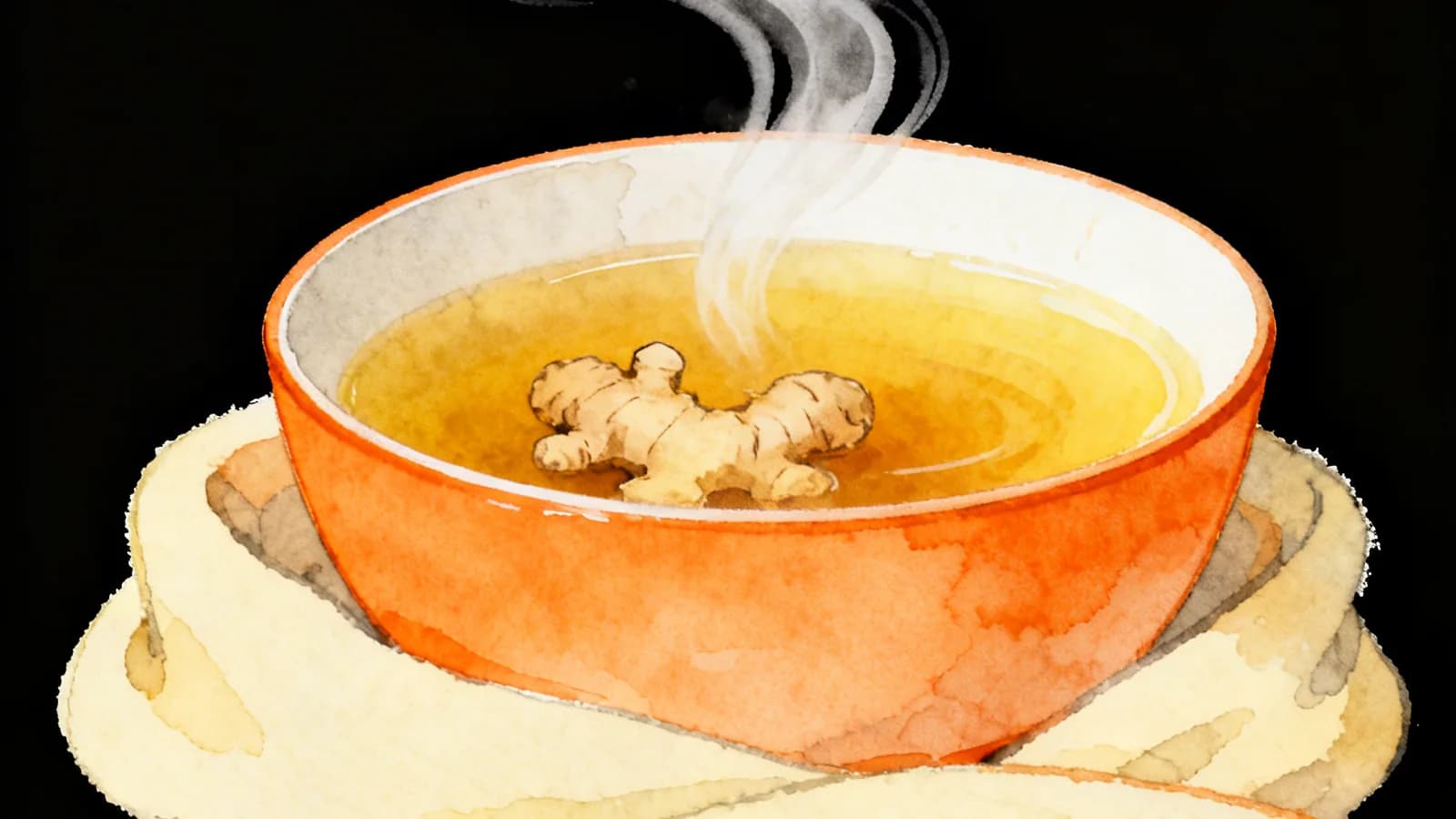
Ginger + scallion white + brown sugar drink: ginger (pungent-warm, dispels cold) and scallion white (pungent-warm, opens yang) both “move outward”, helping the surface open. Brown sugar is sweet-warm, supports the effect and prevents over‑dispersing. Key use: drink warm, cover with a light blanket, wait for mild sweating; once sweating appears, remove the blanket and avoid wind exposure.
Term note
Safety: skip if you have high fever, strong thirst, red face, or sore throat (more like wind‑heat). If you have diabetes, brown sugar is not ideal; use a small amount or omit.
Perilla (zi su) congee: perilla leaf is pungent-warm for exterior release; rice congee protects the stomach — “disperse while supporting”. Take warm until the abdomen feels warm and the skin feels slightly moist.
Term note
Why congee helps: warm fluids support circulation and comfort; it’s a gentle vehicle, not a “strong sweating hack”.
Wind‑heat pattern
Mint + mulberry leaf + chrysanthemum drink: mint is pungent-cool and vents outward; mulberry leaf and chrysanthemum clear light heat. The cool‑pungent combination “vents” heat gently. Key use: warm or cool is fine; sip frequently. The effect is a cooler throat, clearer head, and slight moistness — do not chase sweating.
Term note
If you’re very chilled, this may be too cool. If you’re pregnant, on blood thinners, or have chronic conditions, keep doses gentle and consult a professional.
Term note
Modern lens: compounds in ginger (gingerols/shogaols) have been studied for antioxidant and inflammation-signaling effects (including NF-kappa B modulation in preclinical work). Menthol in mint can create a cooling sensation and may ease perceived throat discomfort. These are supportive comfort tools, not a guarantee of faster viral clearance.
B) Acupressure/massage: guide qi, open pathways
General methods (open qi mechanism): “open the heavenly gate”, “push the forehead line”, knead the temples, grasp Fengchi (GB20). These techniques act on head/face yang channels and quickly open stagnation, dispel wind, and prepare a path outward — useful for both cold and heat patterns.
Term note
These are traditional pediatric/folk technique names. Practical intent: relax the head/neck, improve circulation, and reduce the “blocked” sensation.
Term note
Modern lens: gentle pressure plus slow breathing can downshift the nervous system (more parasympathetic/vagal tone), reduce pain sensitivity, and support sleep. Better sleep and lower stress can measurably improve immune regulation during a cold.
Wind‑cold add‑on: knead Dazhui (DU14) firmly; grasp Jianjing (GB21). Dazhui is the meeting point of yang; deeper warming stimulation can mobilize yang qi and create conditions for mild sweat. Stop when the upper back feels warm and you sense a slight sweat coming.
Term note
Do not bruise yourself. Pressure should be “comfortably sore”. Avoid GB21 in pregnancy.
Wind‑heat add‑on: “clear Tianhe water” (one‑way stroke from wrist to elbow), pinch‑knead Shaoshang (LU11) and Shangyang (LI1). These are “clearing/venting” methods to ease lung/large‑intestine heat. Stop at local redness and noticeable throat/head relief.
Term note
If these terms are unfamiliar: keep it simple — gentle strokes, avoid injury, and focus on comfort + symptom relief.
C) Moxibustion: “use warmth to open what is constrained”
Iron rule: moxibustion is purely a warming method. Its core indication is “cold” and “constraint”. Therefore it is almost a dedicated method for wind‑cold, and is generally contraindicated in typical wind‑heat colds.
Term note
Moxibustion uses heat from burning mugwort (ai). If you already feel hot, thirsty, and have a sore throat, adding heat usually makes things worse.
Term note
Modern lens: local heat can increase microcirculation and change nerve signaling — helpful when “cold/constraint” is dominant. But with strong heat/inflammation, extra heat may intensify vasodilation and discomfort, aligning with the TCM contraindication for typical wind‑heat.
Wind‑cold moxibustion points: Dazhui (DU14), Fengmen (BL12), Feishu (BL13).
Method: use suspended moxibustion and pursue “qi arriving at the affected area”. Focus on Dazhui until warmth penetrates deeper and spreads; the neck/upper back and even the body feel gently and steadily warm. The skin may naturally become slightly moist — this is the sign of yang opening and surface regulation returning. Avoid burning pain and drenching sweat.
Term note
Stop rules: burning pain, strong heat agitation, headache worsening, or sweating to exhaustion = stop immediately.
Part 4: TCM view of illness and boundaries — the built‑in warnings
TCM has its own framework for disease transmission and for recognizing severe conditions. While emphasizing the usefulness of non‑drug methods, we must follow diagnostic principles and stay clear about the applicable scope.
Term note
Practical boundary: if symptoms are severe, rapidly worsening, or you’re in a high‑risk group, non‑drug self‑care is not a replacement for medical evaluation.
- Seek urgent care for breathing difficulty, chest pain, confusion, fainting, or blue lips.
- Seek evaluation for high fever lasting > 3 days, dehydration, severe sore throat, or worsening asthma/COPD.
- Infants, elderly adults, pregnancy, immunocompromised people: use extra caution and get professional advice early.
FAQ
- How do I tell wind‑cold vs wind‑heat in TCM?
- A simple shortcut: wind‑cold usually has stronger chills, body aches, clear/runny nose, and little/no sweating; wind‑heat usually has more fever, sore throat, thirst, and yellow nasal discharge. If unsure, use gentle methods and reassess within 12–24 hours.
- Should I “sweat it out” when I have a cold?
- Aim for mild, comfortable sweating only. Heavy sweating can weaken you and worsen dehydration. The goal is relief + slight moist skin, not drenching sweat.
- Is ginger‑scallion tea good for every cold?
- It fits wind‑cold patterns more than wind‑heat. If you have sore throat, strong thirst, and feel hot, it may aggravate heat.
- Can I use moxibustion if I have fever and sore throat?
- Typical wind‑heat presentations are generally not suitable for warming moxibustion. If you’re clearly hot and inflamed, avoid adding heat and consider medical evaluation.
- What is “release the exterior” in practical terms?
- It means helping the body’s surface regulation return to normal: comfortable warming or cooling (depending on pattern), gentle dispersing, and stopping at mild sweating and symptom relief.
- How long should I try non‑drug methods before changing approach?
- If it’s a light early cold, you may feel a shift within hours to 1 day. If symptoms worsen, fever rises, or you feel very unwell, don’t keep forcing self‑care — get evaluated.
- What are red flags that need medical care?
- Breathing trouble, chest pain, confusion, fainting, dehydration, high fever that persists, severe throat swelling, or worsening underlying disease (asthma/COPD).
- Can I combine this with over‑the‑counter medicine?
- Often yes, but follow label directions and be cautious with combinations. If you have chronic illness or take prescription medicines, ask a clinician or pharmacist.
Common patterns & practical Q&A
Explore practical wellness guides for how to sleep better, breathing exercises for anxiety, constipation relief, bloating relief, and stomach pain prevention.
Sleep Better: Insomnia Tips + Bedtime Routine
A practical system for better sleep: rhythm, downshift routines, gentle acupressure, and what to track.
Breathing Exercises for Anxiety & Stress
Simple 5‑minute routines (slow nasal breathing, box breathing) plus common mistakes and how to track calm.
Qi Deficiency (气虚)
How to recognize it, what usually worsens it, and gentle habits that build your baseline.
Dampness (湿症 / “heavy damp”)
Bloating, heaviness, sticky fatigue? Learn everyday ways to reduce “damp” load.
Constipation Relief: Routine + Diet + Acupressure
A prevention‑first guide to bowel rhythm: fiber, hydration, movement, gentle massage, and red flags.
Strengthen the Spleen & Stomach (健脾胃)
Meal timing, warmth, rhythm, and small routines that support digestion long term.
Prevent Stomach Pain (胃痛)
Common triggers, prevention checklists, and when to seek professional care.
Diet Adjustment (饮食调理)
Simple rules for food choices: easier digestion, steadier energy, fewer flare-ups.
Acupressure & Massage (按摩)
A safe, beginner-friendly routine for digestion support and nausea/stress relief.